
Mazal Dagim St. Old Jaffa 68036 Israel, Email:farkash04@farkash-gallery.com, This site is best viewed with browsers Chrome, IE ,Firefox


Members Login


To join the mailing list enter your e-mail address:
 Send


Shabbat


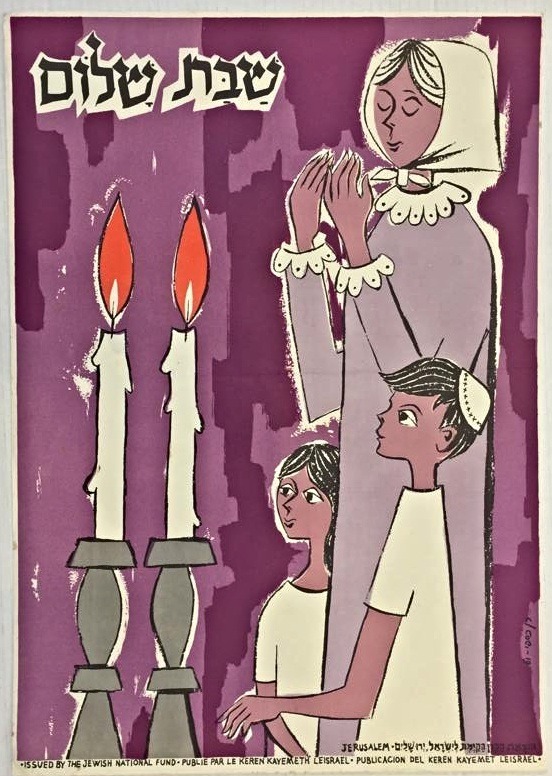
Shabbat (Hebrew: שַׁבָּת, Modern Shabbat Tiberian Šabbāṯ, Ashkenazi pronunciation: Shabbos, Yiddish: Shabbes, "rest" or "cessation") is the seventh day of the Jewish week and a day of rest in Judaism. Shabbat is observed from a few minutes before sunset on Friday evening until a few minutes after the appearance of three stars in the sky on Saturday  night. The exact times, therefore, differ from week to week and from place to place, depending on the time of sunset at each location. In polar areas where there is no sunrise or sunset at certain times of the year, a different set of rules applies.

Shabbat recalls the Biblical Creation account in Genesis, describing God creating the Heavens and the Earth in six days and resting on the seventh. It also recalls the giving of the Torah at Mount Sinai, when God commanded the Israelite nation to observe the seventh day and keep it holy.

Shabbat is considered a festive day, when a Jew is freed from the regular labors of everyday life, can contemplate the spiritual aspects of life, and can spend time with family. Traditionally, three festive meals are eaten: on Friday night, Saturday morning, and late Saturday afternoon. The day is also noted for those activities prohibited on Shabbat according to halakha (Jewish law).


Etymology

The word Shabbat derives from the Hebrew verb shavat. Although frequently translated as "rest" (noun or verb), another accurate translation of these words is "ceasing [from work]", as resting is not necessarily denoted. The related modern Hebrew word shevita, (labor strike), has the same implication of active rather than passive abstinence from work. The notion of active cessation from labor is also regarded as more consistent with an omnipotent God's activity on the seventh day of Creation according to Genesis.

Shabbat is given special status as a holy day at the very beginning of the Torah in Genesis 2:1-3. It is first commanded after the Exodus from Egypt, in Exodus 16:26 (relating to the cessation of manna) and in Exodus 20:8-11 (as the fourth of the Ten Commandments). Shabbat is commanded and commended many more times in the Torah and Tanakh; special sacrifices are to be offered on the day. Shabbat is also described by the prophets Isaiah, Jeremiah, Ezekiel, Hosea, Amos, and Nehemiah.


Origin theories

A longstanding Jewish position is that unbroken seventh-day shabbat originated among the Jewish people, as their first and most sacred institution, whether this Mosaic tradition preserves an origin in special creation, or whether it indicates some obscure later naturalistic origin.Seventh-day shabbat did not originate with the Egyptians, to whom it was unknownand other origin theories based on the day of Saturn, or on the planets generally, have also been abandoned. The Universal Jewish Encyclopedia advanced a theory of Assyriologists like Friedrich Delitzsch(and of Marcello Craveri), that shabbat originally arose from the lunar cycle in the Babylonian calendarcontaining four weeks ending in Sabbath, plus one or two additional unreckoned days per month. The difficulties of this theory include reconciling the differences between an unbroken week and a lunar week, and explaining the absence of texts naming the lunar week as shabbat in any language.


Status as a holy day

The Shabbat table is set: two covered challot, a kiddush cup, two candles, and flowers.

The Tanach and siddur (Jewish prayer book) describe Shabbat as having three purposes:

   1. To commemorate the Israelites' redemption from slavery in ancient Egypt;
   2. To commemorate God's creations of the universe; on the seventh day God rested from (or ceased) his work;
   3. As a "taste" of Olam Haba (the Messianic Age).

Judaism accords Shabbat the status of a joyous holy day. In many ways, Jewish law gives Shabbat the status of being the most important holy day in the Jewish calendar:

    * It is the first holy day mentioned in the Bible, and God was the first to observe it with the cessation of Creation (Genesis 2:1-3).
    * Jewish liturgy treats the Shabbat as a "bride" and "queen" (see Shekhinah).
    * The Sefer Torah is read during the Torah reading which is part of the Shabbat morning services, with a longer reading than during the week. The Torah is read over a yearly cycle of 54 parshiyot, one for each Shabbat (sometimes they are doubled). On Shabbat, the reading is divided into seven sections, more than on any other holy day, including Yom Kippur. Then, the Haftarah reading from the Hebrew prophets is read.
    * A tradition states that the Jewish Messiah will come if every Jew properly observes two consecutive Shabbats.
    * The punishment in ancient times for desecrating Shabbat (stoning) is the most severe punishment in Jewish law.


From Wikipedia, the free encyclopedia
 
 עיצוב,ביצוע וקידום האתר איל סביון [Links]              [Top]             [Add to Favorites]             [Site Map]
LiveCity - Website Builder